Homeowners facing severe biological saturation frequently ask how much is carpet cleaning when dealing with deep-set contamination that threatens both textile integrity and indoor air quality. At Fiber ProTector of Chicago, professional restoration costs vary based on the extent of urine penetration, the affected square footage, the structural involvement of subfloors, and the specialized treatment methods required. Customized estimates ensure homeowners receive pricing tailored to their specific cleaning and restoration needs.
When companion animals suffer accidents on residential flooring, the resulting biological contamination extends far deeper than a simple surface discoloration.
Key Takeaways
- Sub-Surface Extraction is Essential: Standard surface shampooing fails to address the crystallization of uric acid within padding materials.
- Cost Scale is Depth-Dependent: Total restoration expenses scale alongside the depth of fiber penetration and total square footage affected.
- Molecular Neutralization Over Masking: Complete eradication demands specialized enzymatic or chemical counter-agents rather than household deodorizers.
- Subfloor Protection Saves Capital: Addressing structural moisture early prevents catastrophic wood rot and secondary mold colonization.
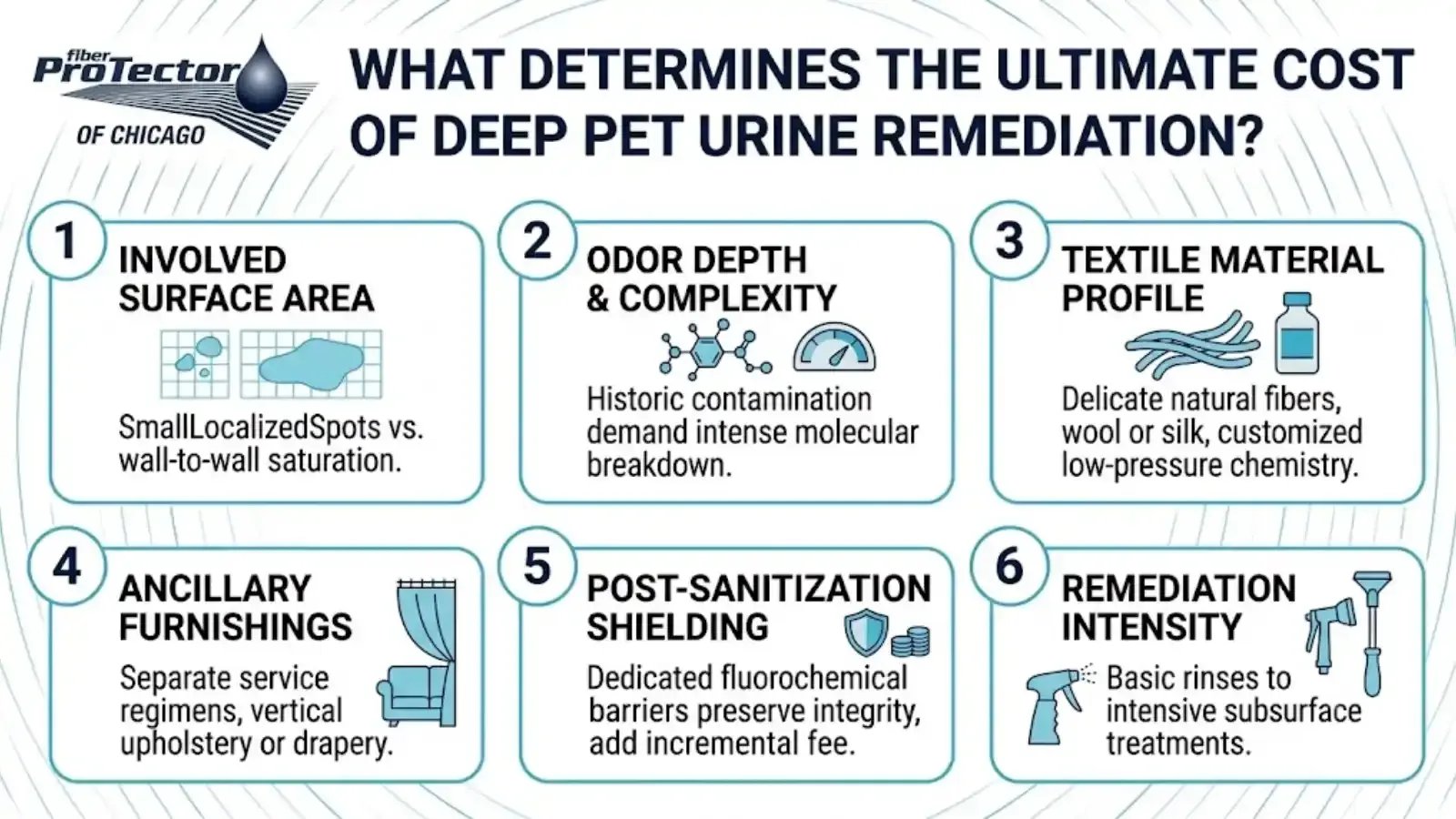
What Determines the Ultimate Cost of Deep Pet Urine Remediation?
The overall financial investment depends heavily on how far biological fluid migrates through textile backing. People must expect budget fluctuations based on distinct building variables. Technicians base their charges on labor hours and equipment runtime. Remediation work encompasses everything from basic rinses to intensive subsurface treatments.
Experts examine multiple areas of vulnerability to determine exact project costs:
- Involved Surface Area: Small localized spots require fewer resources than multi-room wall-to-wall saturation.
- Odor Depth and Complexity: Historic contamination demands intense molecular breakdown which extends the required operational timeframe.
- Textile Material Profile: Delicate natural fibers like wool or organic silk necessitate customized low-pressure chemistry.
- Ancillary Furnishings: Separate service regimens apply when accidents spread onto vertical upholstered furniture or adjacent drapery.
- Post-Sanitization Shielding: Dedicated fluorochemical barriers preserve long-term integrity but add an incremental fee.
How Can You Spot the Warning Signs of Deep Sub-Surface Saturation?
Visible stains represent a tiny fraction of total waste deposited inside rooms. Liquid contaminants follow gravity downward into underlying cushion material. This hidden migration creates a hazardous microenvironment where bacteria thrive.
Environmental Risk Signs
- Moisture Retention Patterns: Sub-surface layers trap ambient dampness to keep lower backing wet.
- Degraded Indoor Air Profiles: The decomposition of urea releases concentrated ammonia gas into breathing zones.
- Pet Re-Urination Triggers: Residual pheromone salts stay inside the floor, which draws animals back to that spot.
Physical Degradation Signs
- Fiber Texture Alteration: Alkaline crystals cause premium carpet elements to become brittle, stiff, and highly fragile.
- Expanding Boundary Pigment: Dark discolorations creep outward long after the initial accident occurs.
- Cushion Mastication: Internal foam padding loses elasticity and yields a prominent localized depression across the room.
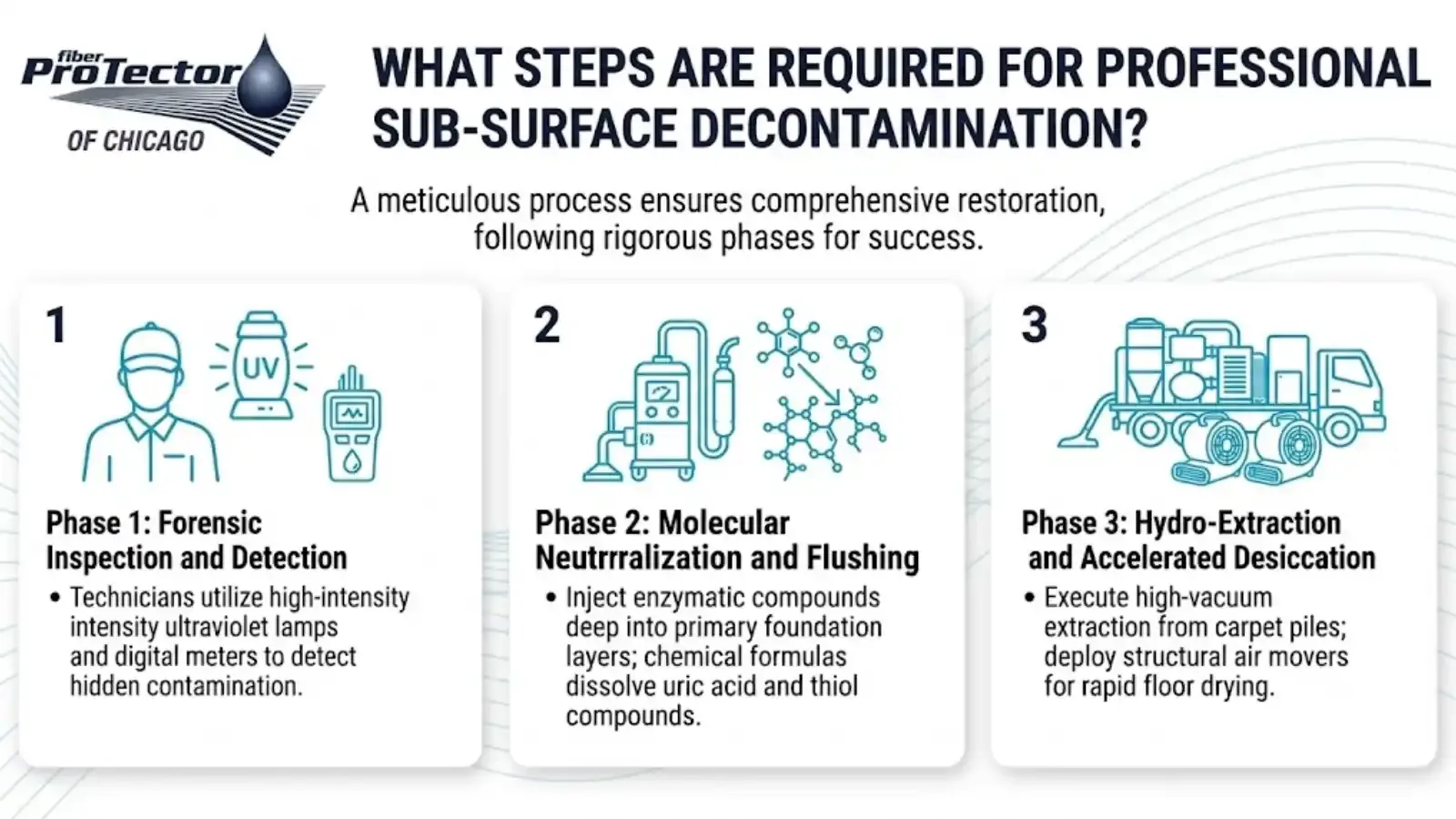
What Steps Are Required for Professional Sub-Surface Decontamination?
Phase 1: Forensic Inspection and Detection
- Map Contamination Boundaries: Technicians utilize high-intensity ultraviolet lamps to identify hidden crystalline deposits invisible to naked eyes.
- Assess Moisture Sub-Surfaces: Digital meters penetrate the pile to evaluate whether wetness compromises wooden subfloors.
Phase 2: Molecular Neutralization and Flushing
- Inject Enzymatic Compounds: Specialized extraction equipment forces low-pH solutions deep into primary foundation layers.
- Dwell and Liquefy: Chemical formulas remain within fibers to dissolve hardened uric acid units and neutralize stubborn thiol compounds.
Phase 3: Hydro-Extraction and Accelerated Desiccation
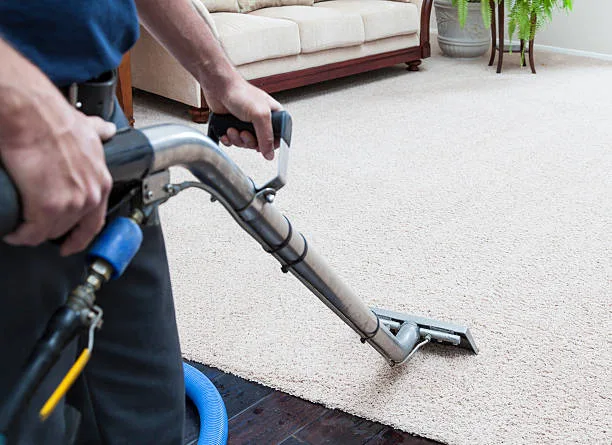
- Execute High-Vacuum Extraction: Heavy-duty truck-mounted machinery pulls contaminated water from carpet piles and deep cushions.
- Deploy Structural Air Movers: High-velocity industrial fans dry the floor rapidly to protect indoor air quality.
Why Do Standard Retail Methods and DIY Attempts Frequently Fail?
Conventional domestic rental machines lack the necessary vacuum lift to extract deep fluids. Amateur operators typically exacerbate problems because they introduce excess moisture and fail to eliminate biological mass.
| Restoration Parameter | Consumer-Grade Retail Efforts | Industrial Sub-Surface Restoration |
| Extraction Vacuum Depth | This process limits suction strictly to upper face fibers. | Advanced systems extract wetness directly from internal padding layers. |
| Chemical Mechanism | Retail products rely on topical masking scents and surfactant fillers. | Professional solutions achieve molecular cleavage of proteins and alkaline salts. |
| Moisture Management | Cheap methods leave textile backing saturated for many hours. | Rapid extraction technology achieves full desiccation within a brief timeframe. |
| Residue Footprint | Sticky soap residues always invite rapid structural re-soiling. | Thorough pure-water rinses completely destroy any leftover chemical film. |
Why Do Premium Area Rugs Require Off-Site Controlled Washing?
Hand-woven area textiles feature delicate construction methods that require gentle care. Standard wall-to-wall techniques deploy aggressive agitation which damages fragile fibers. On-site surface treatment drives liquid waste deep into the foundational yarns.
- Wool Fiber Absorbency: Organic wool strands trap massive fluid volumes before they feel damp.
- Silk Tensile Vulnerability: Wet silk forfeits structural strength and demands unique low-temperature treatment formulations.
- Dye Migration Risks: High-alkali pet accidents destabilize natural plant pigments unless specialists apply proper fixative agents.
- Warp Foundation Saturation: Heavy cotton foundations necessitate total immersion baths and controlled heat tunnels for odor elimination.
How Does Upholstered Furniture Harbor Persistent Animal Odors?
Upholstery fabrics behave like large air filters inside residential spaces. These materials readily absorb airborne contaminants and direct liquid spills. Pet messes quickly penetrate deep into thick polyurethane foam cushions.
- Woven Textile Geometry: Loose fabric configurations allow liquid moisture to pass directly into internal frames.
- Polyurethane Core Absorption: Open-cell structure behaves exactly like a sponge to collect bio-waste permanently.
- Frame Contamination Transfer: Liquid contacts inner wooden supports or spring systems to cause structural rot and oxidation.
- Airflow Odor Displacement: Compressed cushions act like bellows to propel foul aromas into ambient breathing zones.
How Does Post-Restoration Fiber Protection Shield Your Investment?
Specialized protective barriers drastically reduce the absorption rate of future liquid accidents. Advanced fluorochemical coatings wrap around individual fibers to alter surface tension. This shield prevents fast fluid penetration during subsequent pet mishaps.
- Surface Tension Manipulation: Modern protectants cause fluids to bead cleanly to allow safe effortless removal.
- Soil Release Enhancement: Treated strands naturally shed dry particulates to maximize vacuum efficiency.
- Chemical Bonding Integrity: Professional applications cross-link directly with textile substrates to withstand heavy foot traffic.
- Fiber Life Extension: This step stops abrasive grit from damage and blocks premature wear.
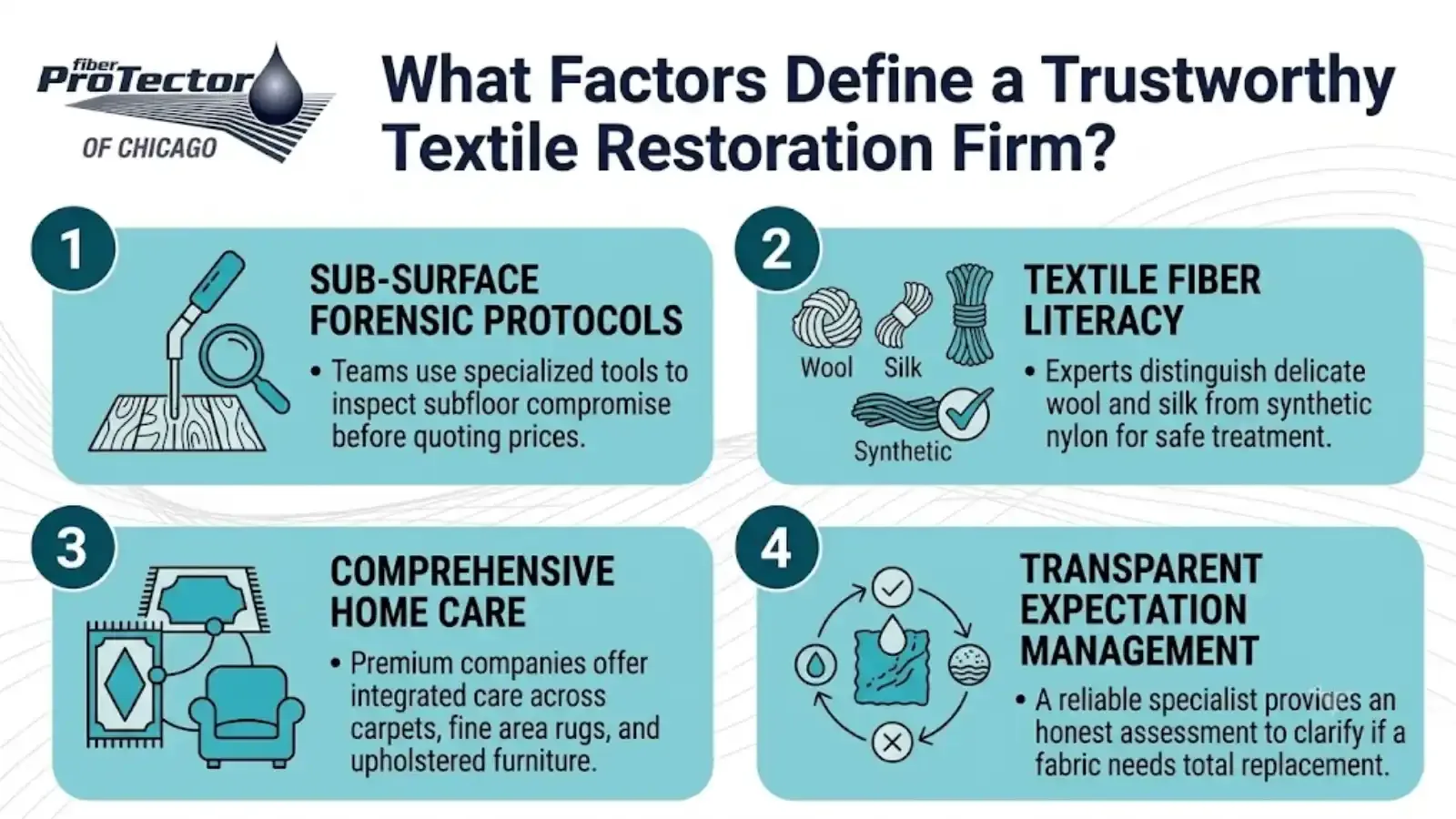
What Factors Define a Trustworthy Textile Restoration Firm?
Cheap telephone estimates often lead to incomplete work and hidden structural costs. True architectural restoration requires specialists who thoroughly understand pet accident chemistry. Reliable crews maintain advanced certifications in comprehensive fabric care.
- Sub-Surface Forensic Protocols: Qualified teams use specialized tools to inspect subfloor compromise before they quote prices.
- Textile Fiber Literacy: Experts distinguish delicate wool and silk from synthetic nylon to ensure safe treatment.
- Comprehensive Home Care: Premium companies offer integrated care across carpets, fine area rugs, and upholstered furniture.
- Transparent Expectation Management: A reliable specialist provides an honest assessment to clarify if a fabric needs total replacement.
Homeowner Perspective
Most service providers avoid a harsh truth about cheap steam specials. Low-cost offers cannot resolve severe multi-year pet saturation across an entire residence. True biological decontamination demands deep extraction tools and extensive labor hours. Careless shortcuts leave uric acid crystals active underneath floors to cause future odor problems.
Restoring Comfort and Air Quality to Your Living Spaces
Property owners who want to know how much is carpet cleaning must shift focus toward complete sub-surface decontamination. Professional crews like Fiber ProTector of Chicago approach pet odor removal as a rigorous scientific process. Technicians locate hidden deposits beneath face fibers to preserve indoor air quality.
Direct treatment of deep-set odor sources preserves fine interior furnishings far better than short-lived topical fragrances. This thorough method ensures a healthy comfortable environment for your family. Contact us today at (312) 446-7530 to book a detailed structural inspection.
Frequently Asked Questions
Q: Can professional service completely remove deep pet urine odors?
A: Yes, specialized treatments completely eradicate deep pet odors through sub-surface extraction tools and enzymatic solutions. These advanced systems penetrate the primary carpet backing to break down hardened uric acid crystals.
Q: Why does the pet urine odor seem stronger after amateur maintenance attempts?
A: Home remedies introduce heavy moisture that reactivates dormant uric acid crystals trapped inside carpet padding. Without high-powered extraction, this damp environment causes bacteria to multiply rapidly and release concentrated ammonia gas.
Q: Should homeowners replace residential carpets instead of arranging a deep clean?
A: Carpet replacement is generally necessary only when biological fluids cause permanent structural rot in the subfloor. A technical inspection with moisture meters confirms whether deep sub-surface extraction can safely restore the textile.
Q: How often should homes with companion animals receive professional deep extraction?
A: Properties with pets maintain cleaner indoor environments when specialists perform deep extraction every twelve months. If your home has multiple pets prone to frequent accidents, biannual appointments help protect your floor materials.
Q: Can specialized stain protection prevent future sub-surface urine damage?
A: Advanced fabric protectants create a temporary barrier that slows fluid absorption to give you valuable cleanup time. However, these coatings cannot prevent deep sub-surface saturation if large amounts of liquid stand on the floor.